Common Mistakes in the Cambridge B2 FCE Exam
Discover the most common mistakes in Reading, Writing, Speaking & Listening papers of the Cambridge exam B2. Boost your FCE score now!
28/Oct/2025
Exams
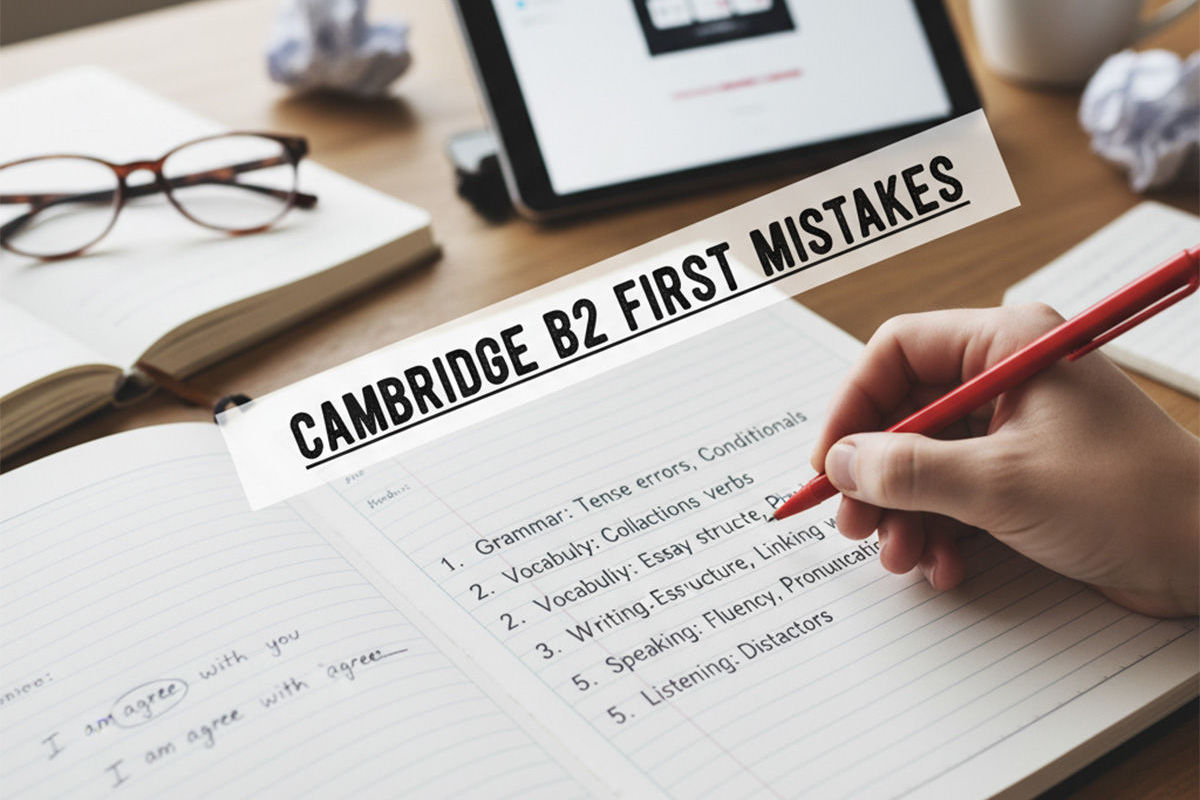
Are you preparing for the Cambridge B2 First (FCE) exam?
Knowing the common pitfalls in the Cambridge exam B2 can be the difference between passing and failing.
As a candidate, you often focus only on theory. However, practicing proper exam technique and avoiding recurring mistakes is essential for success.
Here is a guide to the most frequent errors that B2 students make across all four papers, along with actionable tips to secure your best score.
1. Reading & Use of English Mistakes (Paper 1)
This paper is a significant challenge for many, as it tests both vocabulary and grammar under strict time constraints.
Ignoring the Context (Parts 1, 2, 3): Many candidates choose the first word that seems grammatically correct without reading the entire sentence or paragraph.
Tip: Always read the sentence before and the sentence after the gap. Context determines meaning, especially when choosing between confusing words (false friends) like advice vs. advise.
Over-relying on Word Formation (Part 3): Students often change only the word form (e.g., from noun to adjective) without considering the prefixes and suffixes needed to change the meaning to negative or positive.
Tip: If the sentence structure requires a negative adjective (e.g., impossible), ensure you add the correct prefix (B2 grammar).
Poor Time Management: Spending too long on the multiple-choice cloze or word-formation sections leaves insufficient time for the longer reading tasks (Parts 5, 6, 7).
Tip: Allocate a maximum of 10 minutes per part in the Use of English section. The goal is to pass B2 First, not to achieve perfect grammar in every part.
2. Listening Paper Mistakes (Paper 2)
The main challenge here is distraction and the failure to anticipate the information you need to capture.
Writing Too Slowly (Part 2): In the sentence completion task, candidates often fail to write down the exact word or phrase they hear because they’re trying to write a complete, perfect sentence.
Tip: Write down the key information as you hear it. The instructions state you must use the exact words from the recording. Your spelling must be accurate (B2 listening tips).
Missing the "Trick" (Parts 1, 3, 4): The speakers often mention all the options (A, B, C) before concluding with the final answer. Many students select the first option mentioned.
Tip: Listen for the speaker's final opinion or conclusion, usually introduced by phrases like “However,” “On reflection,” or “But in the end.”
3. Speaking Paper Mistakes (Paper 4)
Fluency and complexity are key, but standard errors often hinder natural speaking.
Lack of Interaction (Part 3): The collaboration task is not a monologue. Students often dominate the conversation or agree without developing their ideas.
Tip: Use precise linking phrases (FCE speaking) to invite your partner to speak (e.g., “What are your thoughts on that, [Partner's Name]?” or “I agree up to a point, but…”).
Simple Grammar and Vocabulary: Relying only on tenses like the Simple Present limits the score. The examiner needs to hear proof of your B2 level.
Tip: Aim to use conditional sentences, perfect tenses (Present Perfect Continuous), and varied vocabulary (B2 vocabulary) when giving your opinion.
4. Writing Paper Mistakes (Paper 3)
The most common errors here are structural and formal, not just grammatical.
Incorrect Register (Formal vs. Informal): Using slang or contractions in a formal email or report (and vice versa) immediately penalizes your score.
Tip: Before starting, clearly identify the target reader and the purpose to determine the appropriate register.
Not Answering All Points: For the essay, you must discuss the two points given and include a third original idea. For emails/letters, you must cover all bullet points in the prompt.
Tip: Highlight the instructions before writing. Allocate one paragraph per point in the body of your text.
Over-reliance on Repetition: Using the same simple connectors (and, but, also) repeatedly shows a lack of B2 connectors or range.
Tip: Practice using complex connectives like Furthermore, Moreover, Although, Despite, In addition to, On the one hand/On the other hand.